A First Community Meeting, Planned Around Listening
Prepare for a first community meeting with one clear question and simple listening notes, so you can follow the discussion without rushing to judge.
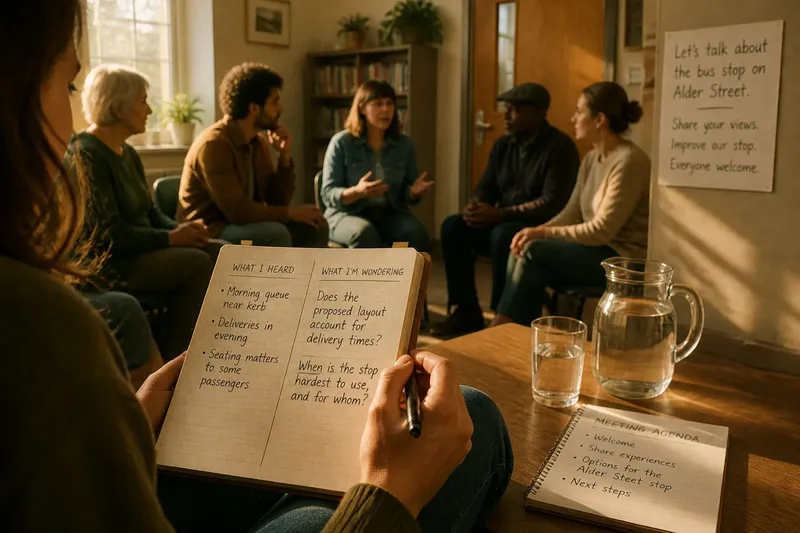
You arrive at the library meeting room just as someone is moving chairs into a loose circle. A hand-written agenda sits beside a jug of water; near the door, a notice invites residents to discuss the bus stop on Alder Street. For a first community meeting, that ordinary threshold can feel like a test: when to speak, what to ask, and how to make sense of opinions that do not match. A small plan can take the pressure off. Come with one question, listen for the answers and leave your conclusions open until the conversation is over.
Prepare a question, not a speech
A meeting can touch on history, complaints, practical limits and ideas for change, sometimes in the same breath. Trying to prepare a response to every possible point turns listening into a hunt for your next opening. Instead, choose one question that would help you understand the issue better.
For a gathering about a bus stop, useful questions might be, “Who uses this stop at different times of day?” or “What changes are already being considered?” The first asks about everyday experience; the second asks what is in motion. Either gives you a clear thread to follow without assuming what the answer should be.
Write the question in plain language. If it contains several parts, trim it until the group can answer without guessing which part matters most. You can keep other curiosities in reserve. A focused question is a listening aid, not a promise that you will take the floor.
It can also help to decide what you do not yet know. Perhaps you have seen a crowded stop in the morning but have not visited in the evening. Naming that gap privately makes it easier to hear someone whose routine differs from yours. You are not required to arrive as an expert on your own street.
Set up notes that separate words from interpretation
Bring a small notebook or use a notes app, whichever lets you listen without fuss. Divide a page into two simple areas: “What I heard” and “What I’m wondering”. In the first, record points that were actually said. In the second, park your questions, reactions and possible explanations.
This separation matters because a vivid comment can quickly become a conclusion in your mind. “The shelter feels exposed after dark” is a reported experience. “Everyone wants a taller shelter” is a wider claim that may not have been made. Short notes help preserve the difference.
Do not try to transcribe the room. Capture a few phrases, the issue they refer to and any detail that changes your understanding. If a speaker mentions a shift pattern, a school run or a delivery route, note the context rather than only the proposed fix. A suggestion often makes more sense once you know which daily routine it is meant to serve.
Leave space beside each note. You may hear another person describe the same place differently, or learn that a concern has already been raised with the local council. The blank space is useful: it keeps your notes provisional instead of turning the first version into a verdict.
Imagine one resident following the discussion
Say you are new to a residents’ meeting about the Alder Street stop. You have walked past it at lunchtime and noticed that people sometimes wait close to the kerb. You do not know what it is like at school-run time, or whether the group is discussing a shelter, a crossing or both.
You write one question before leaving home: “When is the stop hardest to use, and for whom?” At the library, you put it in the margin of your notebook. During the first part of the meeting, a parent describes the morning queue. Later, a shop worker says evening deliveries make the pavement feel narrower. Someone else points out that older passengers often need a place to sit.
Your notes keep these observations distinct. Under “What I heard”, you jot “morning queue near kerb”, “deliveries in evening” and “seating matters to some passengers”. Under “What I’m wondering”, you write, “Does the proposed layout account for delivery times?” You have not decided that one account cancels another. The discussion is showing several uses of the same small space.
When the chair invites questions, you can ask yours if it still fits. Perhaps the group has already answered it. Perhaps the conversation has revealed a sharper version: “Are people considering both the morning queue and evening deliveries?” If you speak, the question follows what you heard rather than a position you brought in before anyone else had a chance to talk.
By the end, the group may have agreed to collect further comments, or it may still be weighing options. Your useful result is not necessarily a decision. You leave with a clearer account of who uses the stop, what remains uncertain and what the next discussion might need to address.
Listen for the shape of the room
Listening means more than waiting for your turn. Notice which parts of the issue keep returning and which experiences have only appeared once. Repetition can signal a shared concern, but it does not establish that everyone agrees. A quieter contribution can add a detail that changes the question, even if nobody immediately builds on it.
Pay attention to what people are responding to. Are they describing something they personally encounter, relaying what a neighbour said, or suggesting a possible change? Those are different kinds of contribution. A proposal may be worth considering without being an established fact; a personal account can be important without representing every user of the place.
There is no need to judge who has the strongest claim while people are still speaking. If two accounts seem to conflict, record both and note what would help distinguish them: time of day, location, access needs or a missing piece of information. That gives uncertainty a place on the page instead of forcing it into an immediate yes-or-no choice.
Notice the meeting’s process, too. Is someone recording actions? Is there a way to send a comment later? Does the group have a clear next step, or is it still gathering views? These practical details help you understand whether the evening is for exchanging experiences, making a recommendation or deciding something. A meeting’s purpose can shape what counts as a useful contribution.
Speak briefly without taking ownership of the room
If you decide to ask your question, keep its context short. A simple opening such as, “I’m new to this discussion, and I’m trying to understand how the stop works at different times,” gives people a reason for the question without claiming authority over the subject.
Then leave room for an answer. Resist adding several suggestions before anyone responds. If a point is unclear, ask for a concrete detail: which part of the pavement, what time of day, or which group of passengers? Specific follow-ups can make a broad conversation easier to understand without turning it into a cross-examination.
You can also choose not to speak. Listening carefully and taking notes is a complete way to attend, especially if you need time to understand the group’s terms or history. A first meeting need not end with a public contribution to count as worthwhile.
If the discussion moves beyond your question, let it. People may raise access, maintenance, lighting or responsibility for contacting the council. Note which matters seem connected and which belong to a separate decision. You are there to understand the gathering, not to force every topic back to your own starting point.
What should you do before your first meeting?
How do you choose a useful question?
Choose a question that would clarify the issue rather than smuggle in a preferred answer. Ask who is affected, when a difficulty occurs or what the group is trying to decide. Keep it to one main point so you can follow the response.
What should you bring?
A notebook and pen, or a notes app, are enough for most informal gatherings. Bring your written question and leave space for follow-up thoughts; avoid making a recording unless the organiser and participants have agreed to it.
Is it all right to attend without speaking?
Yes. You can listen, learn how the meeting works and decide later whether you have a useful question or contribution. If you want to participate another way, ask the organiser whether written comments or a later conversation are welcome.
How should you handle conflicting accounts?
Record what each person said without blending the accounts into a claim of general agreement. Note the circumstances each person described, then leave a question mark beside anything you cannot yet reconcile.
Leave with open conclusions and a clear next action
Before you put your notes away, mark three things: what you heard more than once, what remains uncertain and what the meeting will do next, if anything. Keep observations separate from your own interpretation. A useful note might say, “Two people raised the morning queue; the proposed change is not settled; organisers will gather more views.” That is more accurate than writing, “Residents support a larger shelter,” unless the room actually reached that position.
Afterwards, give your impressions a little space. Re-read the notes when the noise of the room has faded. You may notice that a comment you first took as opposition was a request for more information, or that two apparently competing concerns apply at different times. Let new context alter your view.
If you want to stay involved, choose a modest next action that follows from the meeting: check the organiser’s follow-up notice, send the question you did not get to ask, or attend the next gathering. If the group is still collecting experience, avoid presenting your own notes as a complete picture of the neighbourhood. They are a record of one discussion, not a survey of everyone who uses the place.
A first community meeting can be useful even when no decision is made. Arrive with one question, keep careful notes and allow the room to complicate your first impression. That is the quiet value of a first community meeting: you leave not with a finished opinion, but with a better question and a more grounded sense of what deserves attention next.