Pocket Park or Plaza: Two Different Places to Pause
Pocket park or plaza? See how planting, paving and layout shape a pause, from quiet shade and informal play to passing encounters and public events.
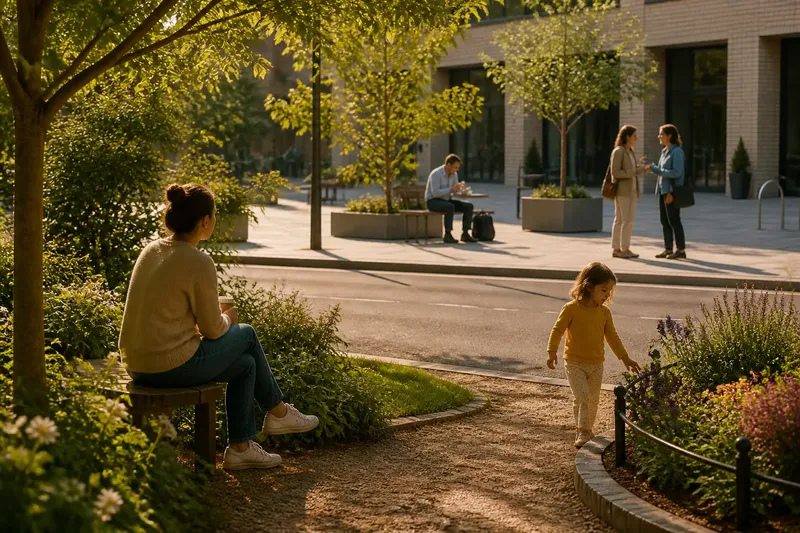
At a pocket park, someone pauses beneath a small tree while a child circles the edge of a planted bed. Across the street, a plaza holds a commuter eating lunch and two neighbours greeting each other in the open. Both spaces offer a place to stop, but their ground, edges and routes invite different kinds of lingering. A pocket park or plaza is not simply a choice between grass and paving; each gives everyday public life a different setting.
Start with the ground beneath a pause
A pocket park is a small public green space, often fitted into a spare lot, a street corner or a gap between buildings. It may have trees, shrubs, a patch of lawn, planting beds or a mix of soft and hard surfaces. Its size can make it feel tucked away, even when it sits beside a busy road.
A plaza is generally an open, mostly paved public space. It may sit in front of a civic building, beside shops or at a junction where several walking routes meet. Trees, planters and fountains can soften it, but its defining impression is often an open surface with room to cross, gather or pause.
These are useful descriptions, not rigid rules. A compact square with a grove of trees may feel park-like; a paved forecourt with a lawn at its centre may work like a plaza. For a visitor, the important clues are less the official label than the surfaces, shade, routes and activities the place makes possible.
Planting gives a small space a quieter rhythm
Trees and planted edges can make a pocket park feel sheltered. Leaves move in the wind, birds may forage in shrubs, and the view is broken into smaller pockets rather than one broad expanse. A person sitting near a garden bed can feel separate from the pavement without being hidden from public view.
That enclosure often suits pauses that are unhurried or companionable. Someone might read, eat a snack, watch children play or chat with a neighbour. Planting also gives people something to notice while they sit: a change in light, a flowering patch or a gardener tending the beds.
Greenery does not automatically make a place restful. Dense planting can obscure sightlines or make a route feel uncertain. A narrow path between beds may be pleasant for a slow stroll but awkward for a person wheeling a pram or using a mobility aid. The question is how planting meets the paths and seating, not simply how much green appears on a plan.
Consider also how the space changes through the day. A tree can shade a seat, while a sunny opening may attract someone seeking warmth. Shrubs can buffer the view of traffic, yet leaves and branches need care. A pocket park asks its surroundings to accommodate living material, which brings seasonal variation and ongoing maintenance into the experience.
Open paving supports movement and shared attention
A plaza’s open surface makes routes legible. People can see where others are going and choose a direct line through the space. That can be useful where foot traffic comes from several directions or where a public building needs an accessible approach. The plaza is less a tucked-away room than a shared floor.
Openness also changes how people encounter one another. A passer-by may spot a familiar face from across the space. A small gathering is visible to others, and an event can be seen from the edges as well as the centre. These encounters can feel lively, though the same visibility may make a solitary visitor feel exposed.
Hard paving is adaptable. It can accommodate a market stall, a community noticeboard, a performance or a temporary installation, provided the layout and local arrangements allow it. Clear ground also makes it easier to move through without weaving around planted beds. But wide, bare surfaces can feel harsh in strong sun or wind, and can offer little reason to remain once a person has crossed them.
Plazas often depend on their edges to make the open centre comfortable. A café frontage, a low wall, a row of trees or a sheltered building entrance can give people a reason to stop. Without useful edges, a plaza may function well as a route yet feel thin as a place to spend time.
Edges decide whether stopping feels natural
In either setting, a pause needs a place to land. Seats are one option, but a low wall, a broad step or a sheltered ledge may serve a similar purpose where permitted and suitable. The position matters: a seat facing a path encourages watching and greeting, while one turned towards a garden offers a more inward pause.
Edges also influence how comfortable it feels to join a space. A pocket park with a clear entrance and a view across its interior can feel welcoming without being fully exposed. A plaza with active shopfronts or a building entrance can feel watched over by ordinary activity. By contrast, a blank wall or a hidden corner may leave visitors unsure whether the space is meant for them.
Imagine a small paved forecourt beside a library, with a few trees in large planters and a low sitting edge along one side. A person arriving to collect a book could sit briefly, watch the entrance and leave without crossing the centre. If the planters instead formed a dense enclosure around the sitting edge, the same pause might feel more private but the entrance could be harder to see. The observable difference is not a promise about how every visitor will feel; it is a change in visibility and route choice.
What kind of pause does each place invite?
Where might a pocket park feel most comfortable?
A pocket park may suit a short break from traffic, informal conversation or a quiet moment beside planting. Look for a path that is easy to understand, a place to sit and enough visibility to feel connected to the street.
When does a plaza make a better meeting point?
A plaza can work well when people arrive from different directions or need room to find one another. Its open centre makes faces and movement easier to see, while a sheltered edge can give a group a place to wait.
Can a plaza feel calm without becoming a park?
Yes. Trees, shade, a water feature or a quieter seating edge can soften an open paved space without changing its basic role as a route and gathering ground. The balance depends on leaving clear paths through the space.
Can a pocket park host a community gathering?
It can, especially for a small, informal gathering, but narrow paths and planted areas may limit how people arrange themselves. A plaza usually offers more open ground for a group, while a pocket park can make a smaller gathering feel close-knit.
Read the space by watching what people do
A quick visit can reveal the difference more clearly than a label. Notice whether people cut straight across, follow a winding path, sit alone or stop in pairs. See whether they gather at the centre or along the edge, and whether the place offers shade or shelter at the time you visit.
Look, too, at how different visitors use the same ground. A child may treat a low wall as a perch; someone carrying shopping may need a direct route through; an older neighbour may value a seat close to an entrance. A space can support several rhythms when its paths are clear and its stopping places do not block one another.
These observations are not a scorecard. A busy plaza is not necessarily better than a quiet park, and a secluded green corner is not automatically more welcoming. The useful question is whether a place offers the kind of pause its surroundings need, while leaving room for people who are only passing through.
Choose for the public life around the site
A pocket park tends to draw attention towards planting, smaller routes and pauses that can feel sheltered. A plaza tends to foreground movement, shared visibility and gatherings that need open ground. Neither is inherently more civic. Their value comes from how they connect to nearby homes, services, shops and walking routes.
For someone deciding between them, begin with the daily pattern around the site. If people need a little green relief from hard streets, a planted space may answer that need. If they need a clear meeting point or a flexible forecourt, open paving may fit better. Many places borrow from both, but the central design choice remains: should the pause feel like a small retreat, or like a moment within the flow of public life?
That distinction is useful when visiting as well as planning. Next time you stop in a pocket park or plaza, notice where your feet slow down and what holds your attention. The shape of that pause can tell you what the space offers, even before you know its name.